‘And if I have not changed that goes to prove
That I am monstrous’
-W.B. Yeats.
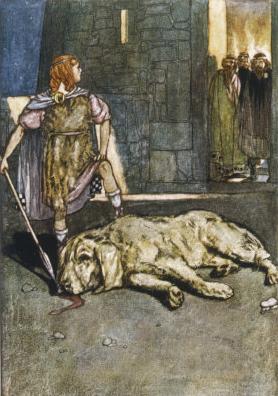
The child is barely old enough to remember his own name when the dog attacks. Chained outside the smithy, the creature has strained all day against the iron that chokes the breath from between its blackened teeth. The hammer of its caretaker, Chulainn, personal blacksmith to King Conchobar, screams against the anvil. The shrieking clang whips the mongrel into a frenzy. Soon, it knows, it will be let loose to prowl through the night to hunt any intruders who have slipped behind the village walls. Yet the creature is impatient, driven mad by the leaden rhythm of the forge. Drool pools from between dark lips pulled tight over jagged fangs.
Its bindings have weakened. The brute can understand this. Quivering snout, tarred with snot and rabid ooze smells…. something, small, young… approaching. The chain shatters. The dog barrels forward, rushing, gasping, leaping through the shadows, and the child is there. Something is wrong. The animal realizes it before its leap has been completed. Its haunches lock in an instant of sudden, instinctive terror. Other shapes are bursting from the dark, larger ones, yelling in shock. A small hand grabs the dog by a tattered ear. A whine turns into a splatter, turns into a thud, and the shape of the beast goes limp, becomes a thing of dripping meat.
The men of the village of Emain Macha shrink back in horror. The child, breathing heavily, watches bits of the animal’s skull fall from his fingers like sea-shell shards. A buzz of whispers. The beast is dead. The beast that kept Ulster safe from wolves, bears and roaming brigands, the terror of Ireland that kept our enemies at bay, is done for.That monster-child again. Always destroying. Always stained in blood. The dog’s handler emerges from the smithy, wailing at the ruined corpse. His hammer is a dark mushroom in his fist as he whirls on the child, the strange thing, half-mortal, faery touched.
The wyrd boy with the horrible eyes.
What will keep us safe in our beds now? The men take up his cries. What will guard us from the dooms of Ireland?
The child, still quivering with fear, replies as only a boy would.. Desperate to stop the angry hisses, the snarls of disgust. The child gives up the name he can barely scratch out on a piece of slate. Please. I will guard us. I will take the creature’s place. I can make it better; I can be a better attack-dog than he ever was. I will be Cú Chulainn, the dog of the smith. Please.
This he swears. This is his oath. This is his curse.
I shall be the Hound of Ulster.
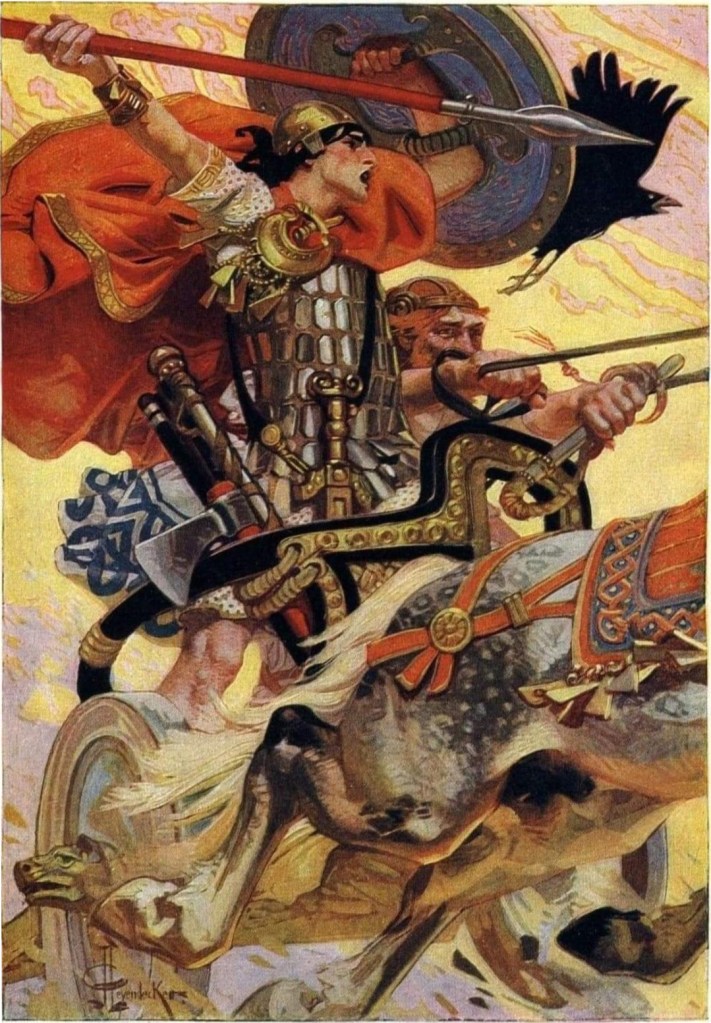
The mist was cold silk trailing low against the grass as the chariot drew to a halt on a sloping hillock. It rattled gently when it stopped. A thicket of spears bristled from its sides, fitting plumage for the war-cart of King Conchobar’s fiercest warrior: Cú Chulainn, he who was born of mortal, God and faery. Mightiest champion of the Emerald Isle, first and only son of Lugh the flame-clad god of battle. Stood at the reins, the familiar seat of his boyhood service to the hero, was Láeg, master of horses. He slowed the beasts down with a flick of his wrists. In the pale glow of dawn hot breath steamed from between the horse’s tombstone teeth. The first horse bent his neck and began to graze. His companion followed suit. Now there was no sound across the plains, save for the champing of teeth tearing jade hairs from the back of the rain-fat earth.
Láeg dismounted from the chariot. The raven-feather mantle of his jerkin bristled with the sweat of the early morning. The lad, his cheeks still downy with fluff, fussed over the stallions as they ate, whispering in their twitching ears and tracing the bony ridge of their snouts. He had been given to Cú Chulainn by Conchobar as a reward, years ago, a gangly brat who had only ever heard the stories of how the demigod had butchered the invading hordes of their war-ready neighbours of Connacht, polluting the river crossing of Ulster with the slain. Give a dog his bone, the King had joked. If Láeg resented his role as a tool, he did not show it. Flitting between the beasts, he was limber and loose in a way he had never been whilst surrounded by the rough and lusty bannermen of Ulster.
At the back of the chariot, his master gazed at the boy through rainbow eyes.
It was the first thing that struck any mortal when they met Cú Chulainn. Not the red gold of his mane, curling like the hidden heart of a hearth’s flame, or his beardless chin which refused to sprout hair, though he was no longer a young boy. Not his size, which dwarfed even the most strapping Ulsterman, or his curious way of moving, as if calculating how to leave a hair’s width of space between himself and the world.
No, it was those eyes, that shimmered with the jewelled hues of a river’s spray touched by a bough of sunlight. The half-moon stare of a wildcat that had traced the end, in the gloom of midnight, of so many of the would-be-heroes of Connacht. Mortals could not boast such diamonds to stud their heads. Grown warriors, hardened by axe-blade and spear-tip into chips of flint, feared to meet them. Even under the covenant of a meal of bread and salt, the most hallowed oath of all. They would mumble into their beards, flinch if he stood up too quickly, burn their tongues in their eagerness to be done. Their daughters would turn their backs to him when they made love. He could sense them trembling involuntarily as he went to cup their waists, had felt a rabbit shake like this as it waited for its neck to be broken. These days his hands seldom strayed from his person.
Now Cú Chulainn looked across the plains. Faint blotches were starting to deepen under his eyelids. It may have been a trick of the light, but his frame seemed to sag momentarily, before he righted himself. He turned his head upwards, studying the sky.
A lone raven was flying in circles overhead. The raven croaked its curses to the heavens and perched on a rock. There was a red strip of meat in its mouth. It matched his stare, jerking its head to the side. Come and see. His fists clenched on the sides of the war-cart. When he withdrew them, the imprints of his fingers had dented the bronze edges.
The chariot rocked slightly as Cú Chulainn stepped off. Láeg did not look up from his horses. He had accompanied his master too many times to bother questioning him. To stray from the war-cart would be to spit in the face of a bond written in bloodied axles and the cracked skulls of men ran under the hooves of a demi-god’s steeds. Before he left him, Cú Chulainn planted a kiss on the youth’s brow. When he touched his shoulder, the pads of his fingers barely brushed against the flesh. Láeg did not freeze as the hero’s hand settled over the bone. The kiss burned quietly against his freckled skin. No other words needed to be spoken. If they had, it would not have meant anything.
Cú Chulainn turned away quicker than expected. His head kept moving to where the bird was waiting. The raven beat its wings, scattering feathers. The demigod glanced over Láeg’s shoulder. He had been doing so, at brief intervals, the entire journey. The bird hooted its impatience. Cú Chulainn sighed, straightened himself to his full height, and began to walk.
Absentmindedly shooing the damp muzzle of a horse away, Láeg watched Cú Chulainn as he moved across the plain. His quicksilver stride carried him across the slippery dirt with inhuman speed, so that he seemed to be skating on the mist. His red cloak fluttered at his heels, following the trail left by the spectre of the sunset. Then the fog swallowed him for good.
Cú Chulainn crested another hillock and came upon what he had expected to see. At least, something of the kind.
All around him were the spider-web walls of haze, a cushion pressed over the mouth of the world. Had he been here before? The day that his fever broke, as they tended to his wounds after the battle with Connacht, he had stopped by in a place like this, lingered, and left. The fog flickered with traces of warmth, orange brushstrokes against pearl.
Cú Chulainn wrapped the cloak around himself tighter. Was the fog streaming from his ears, pulled out of his head? Druids could craft such a trance. For a moment, he heard the far-off sound of the sea. He frowned, concentrating. His eyes shimmered. There were shapes in the mist. Ah. Yes, of course. Her. The smoke parted.
A campfire was crackling merrily in a ring of stones, burping embers as kindling snapped and popped. Next to it, a beautiful brown heifer, speckled white and with inky, mournful eyes, was chewing at its curd. Three teats swung near the grass as she fed. There was a stool by the campfire and a pail of water and an old woman whistling to herself through puckered lips as she washed pieces of armour. It was armour Cú Chulainn recognized well, for it was his own.
A muscle rippled in his neck as his jaw clenched. An old set from his boyhood that he had outgrown. He did not think he would have ever seen it again. Not since they had sliced him out of the mail and leather glued onto him with the crust of his injuries after the victory over Connacht.
The grandmother looked up at him as he approached. Her withered face peeled open into a grin. Her sleeves were rolled back, revealing arms lined like rocks after a century of winds. There was a smell about her that Cú Chulainn remembered from the bones in a box he had been told was his mother. The tips of her fingers were bronze where they rubbed at the bloody streaks that crossed his leather jerkin. Gray, ashy locks fell across the grandmother’s brow, black beads of lice crawling across the thinning parchment of her scalp.
She had begun to sing a song he knew from the nursemaids in the village of Emain Macha. The lullaby was interrupted when Cú Chulainn spoke. He did not raise his voice. It cut through the surrounding sounds, humming with the crystal pitch of a wet finger drawn across the rim of a drinking glass.
‘Greetings, seanmháthair.’ Even though he had used the proper form of address for the aged stranger, he kept his hands on the hilt of his sword. The crone looked up from her work again, feigned surprise, and bowed her head deferentially.
‘Ho there, young ‘on, beardless boy, scarlet-clad hero,’ cawed the old woman.
Overhead, the raven screeched. It was hard to tell which voice belonged to who.
‘Strange day to polish armour,’ noted Cú Chulainn. The crone shrugged.
‘No stranger day than any other, lad. The right day, awk, many might say, had they the imbas forosnai, the trance of all-seeing and truth-telling,’ she remarked.
Cú Chulainn clicked his tongue.
‘So then, old mother, you are cursed with the poet’s gift?’ he asked. ‘Yet you waste it, washing the garb of the fiercest of the Gaels, though no blade has opened him since he was a lad.’ The old woman wrung her hands, spraying the fire with droplets of water. They hissed where they touched the flame, filling the air with the stink of charnel.
‘Whether I clean or not, it makes no difference to a gore-painted pup,’ she rasped. ‘Were you to remove your cloak and stand before me like the day you were born, you would still be bloodied.’ The raven landed on the back of the cow. It ruffled its feathers and picked a strip of skin from the heifer’s spine. Cú Chulainn’s eyes narrowed, but he was smiling wanly, the grin of a man who finds himself accompanied by someone who, though not a friend, is at least a familiar face.
‘And you would still dabble in riddles. Speak true. Is it one of the shapes of the Mistress of Fate and Death that stands before me?’
The old woman’s laugh was toothless. When next her eyes met Cú Chulainn’s, they were the dark purple of ruined king’s shrouds. A more fitting look for the Phantom Queen, the Goddess of Destiny and Despair that had shadowed Cú Chulainn with black-feather footsteps ever since he toddled from the cradle.
‘Right, you is, young ‘on,’ she purred. Cú Chulainn stood his ground, even as he felt something stalking up to him from behind, creeping with vulpine patience. He dug his heels into the soft clay of the land. He did not break eye contact, even when he could have sworn that hooked hands were starting to tug at his cloak. Chulainn let go of the sword. There was a proper way of doing these things. Besides, this was not the first time he had encountered the Goddess, though when they had initially met her chosen form had been far more welcoming. He cleared his throat.
‘Then I name you the Morrígan, Great Queen of our Gods, the Tuatha Dé Dannan. Shadow of the Emerald Island, rider of dark clouds. I name you Raven of the Slaughter-Field, maiden, mother and crone, she-who-is-three,’ intoned Cú Chulainn. The crone nodded.
‘Awk, then I name you Cú Chulainn, he who renounced his human name, thrice-born son of Lugh. I name you the Distorted One, dread wielder of the Gáe Bolga, battle-dog of the Ulstermen,’ replied the Morrígan.
The feeling, heavy and thick that had permeated the air as they spoke, leeching out of the fog, vanished suddenly. Once the Oldest Game, the naming of things, had been completed, both parties could rest easy. To be named was no trivial detail. It was to be seen, confirmed, distilled and understood. Cú Chulainn brushed his cloak further over his shoulder and sat down opposite the campfire. There was something of the princely swagger of his heyday in the squaring of his jaw, yet as he shifted the scarlet cape it spoke of a gesture grown more practiced than passionate.
A pot was bubbling over the flames, lumps of grey meat stewing in broth. The Morrígan left the pail of water, letting the armour soak. With shaking hands, she grasped the pot, though if she felt the pain of the searing hot metal against her naked flesh, she did not show it. She spooned out the meat into two earthen bowls, sprinkling the meal with a dash of salt. Cú Chulainn watched her as she worked. There were rules to this sort of thing. Forces greater than either of them were quick to hurl calamity onto the heads of those rash enough to dishonour the rules of hospitality.
‘Eat up, eat up, you have grown thin since last I saw you. Have a little more, laddie, just a bit,’ she fussed, funnelling more food from her bowl into his, gesturing for him to take it. He accepted, but did not eat. Even without trying, he moved so quickly that the bowl was in his hands before the Morrigan’s fingers had even finished opening. She gave no reaction.
‘Surely child, you knew it was I when you saw me,’ rattled the Morrígan.
Cú Chulainn nodded. ‘I guessed as much when I saw the raven.’
‘Yet still you decided to play, like a wee ‘on, at guessing games?’
‘It has been a long time since we did, Great Queen. Not since you came to me in a different guise, the day I began the struggle against the Connacht men. Maybe I missed your tricks.’
The Morrígan cackled and spat into the fire. ‘A right devil you were, young pup.’ One crooked finger tapped at the yellow flesh under her eye. ‘It still smarts sometimes, from where you tore it out.’ She spoke of her mutilation as one would recount finding a hole in their boot. ‘Awk, mouths should not flap, they should feast, come, eat.’
Cú Chulainn smiled thinly. The Morrígan gestured with her steaming bowl, breaking crumbly bread for the two of them as she did. Cú Chulainn inspected the stew closely, raising a spoon with a glob of meat before his rainbow eyes.
‘The smell is odd,’ he muttered. ‘You would regret it if poison had found its way into my bowl. The Gods have a way of settling debts with oath-breakers. Even one of their own.’
His voice was low but throbbed with the memory of broken ribs and gouged out eyes. The Morrígan was watching him, her violet pupils’ pinpricks in her sunken face.
‘Fret not, It is a meat that suits you well, Distorted One. What more fitting a meal thana real hound, served to the war-dog of Ulster?’
Cú Chulainn set the bowl down by his feet with a dull thud. His other hand drifted as if pulled along by a mind of its own to the weapon strapped to his back. At first glance it seemed an ordinary spear, its shaft polished ash, handle a ghostly ivory. Yet there was something deeply wrong about its head. Serrated edges bit ravenously at the air, and when they caught the sunlight, they darkened it, gangrene blossoming putrid tendrils from a wound.
Cú Chulainn’s fingers hovered over it, but his back had stiffened. His hands trembled as they neared the wood, as if they were loath to touch it. The Gáe Bolga, cursed weapon passed down by the warrior-woman Scáthatch to her worthiest pupil after a year of training. Wielded by Cú Chulainn, the nightmarish thing had accrued such infamy that Conchobar would urge the warrior to hide the spear whenever emissaries visited court. More than one messenger had fled Emain Macha when they caught sight of the weapon, driven out of their wits by the legend of its carnage.
‘Oh?’ clucked the Morrígan, her mouth the gummy maw of a snake. ‘You would strike me down, puppy?’
‘You know why, Great Queen. The enchantment I was born with, the fae-charm that grants me victory in battle, forbids me to eat dog-flesh. Why now, of all times, would you have me break the geas that binds me? Revenge? The battlefield where first we met has long passed. I did not think the gods held such grudges.’ His hand had not moved from the spear.
‘Bah, nothing so petty,’ said the Morrígan primly. ‘I bear you no hatred child. Even as a son of Lugh, your life is a snowflake in spring to the likes of the Tuatha Dé Dannan. Your geas needs be broken because that is what your fortune commands. Fate has decreed it so. I am merely she who ensures destiny has its due. Put up your blade and your spear, wee’on.
Would you skewer the rain for falling, or the moon for rising in the night? It is the way things should be, and thus will be. You have known this since it was foretold to you by Cathbad the
druid, that day you took the arms of Conchobar.’
Cú Chulainn sat back, letting his arm fall. Cathbad, that little old man with the watery eyes and dusty grey beard, a playground for spiders. He had always adored children, yes, even Cú Chulainn, who at six years had been deadlier than a man fully grown. Oh, and how he had loved telling stories, shrouded in the fog of his hut, spinning yarns to the gawping brats that crowded around his lap. Stories of the faery Sidhe, the wee folk. Stories of travellers that sailed over the rim of the world, a stone with a hole that gave you second-sight and a fish whose flesh granted all-knowing, and a story that prophesized that he who could bear arms as a child would become the mightiest of the Gaels.
Well, why wouldn’t he have tried it, then and there? Who could have blamed him for dashing off to find weapons, instead of waiting, shifting his feet impatiently, for the old goat to finish his tale? Sat across from the Morrígan, as he stared at his calloused palms, he could hear the wood splintering and the metal bend. How bronze shattered and bows split as the hands of Cú Chulainn the boy mangled them. No common weapons had sufficed for the son of Lugh, none save the ivory-hilted blade of his King, Conchobar.
When he had lifted it above his head, his smile had sparkled with the light of boyhood deeds and story-book promises.
He should have stayed and let the druid finish the story. He had left before Cathbad revealed that, though the wielder of arms would be immortal throughout song and legend, his body would soon lie cold in the dirt, cut down before old age by the caprice of destiny. The kindly little man had wept into his beard when they told him of Cú Chulainn’s impatience. He had sat down to explain his doom, hugging him, actually touching him, oh lad, oh you poor, sweet child. Later that night, alone where no one could see him, for the first time in his life clear rain had fallen from those rainbow eyes, soft and silent. They had not fallen ever since, no matter how thick they welled in his throat.
War-dogs do not weep. The Great Queen’s words had found their mark. He had guessed her purpose once he saw the foul, black bird, just as he had known her identity. Now he was certain. What had she said, when first he crossed path with the Mistress of Ravens?
‘It is at the guarding of thy death that I am; and I shall be,’ said the Morrígan across from him, and now her words were doubled by the echo of a much younger woman.
Cú Chulainn picked the bowl up again.
‘You have broken bread and salt over this meal, Morrígan,’ he noted. ‘I have no choice. I must eat: the covenant of a shared hearth gone unhonoured will doom me far more than the breaking of a geas would.’ He took up the spoon. ‘Subtle. You have outdone yourself.’ Cú Chulainn felt no malice towards the wizened hag squatting on her stool. They had fought, and more, in the past. It had been a game he had accepted his part in the moment he took up arms. He would not throw over the board and sulk in the corner with his toys when he lost. The hot meat rested comfortably in his stomach. When he had finished his meal, he felt the geas withdraw, an oily sheen peeled slowly from the skin. His death was lurking in the edges of the fog, watching him. Come a little closer.
Cú Chulainn looked at his hand. Was it shaking? Maybe for a second. He wondered if the mist was dulling his fear. He caught his reflection in the pail of mirrored water. The raven fluttered into it. He saw his face dissolve and was relieved to no longer have those multihued eyes staring back him. Oh. Was that how people felt? He breathed out slowly.
‘So, what will happen now?’ he asked the Morrígan. He knew she already had the answer but did not care.
‘You are pursued by Prince Lugaid, son of Cú Roí, King of Munster. The hound has become the hunted, harried across the fields of Ireland. His executioner burns with the fire of an avenging son and brings a great war-host behind his chariot, thick as salmon in the stream.’
‘I know. I have managed to stay ahead, this far. Each day he gains more ground. It is…unsurprising. Ever since I struck his father’s head from his shoulders, I imagined that this day would come.’
‘How noble, hound. I thought you only savaged those your masters loosed you upon,’ giggled the Morrígan. Another voice, high, playful, and devoid of the creak of old age was bubbling out of the hag.
‘This was…different. There was a woman. The daughter of another king. Bláthnat.’ Her name sounded wrong on his lips, as if he should have asked permission to dare speak it aloud.
‘The great Cú Chulainn, brough low by a woman,’ laughed the Morrígan. Something that could have been a flicker in the air, and now where a hunchbacked hag had sat, there was a young lady, the Phantom Queen’s maiden form. She wore a dress of many colours that scattered, swift as fish, into one another. Her black hair tumbled, spilled ink, across her collarbones. The liver-spotted skin had become smooth, the scrawny purple eyes swapped out for polished amethysts.
‘You should have eyes only for me. I have known you longer than any of those doe-eyed tarts,’ she pouted with ill-concealed jealousy.
‘This was no mere woman,’ muttered Cú Chulainn. The worst truth of all was that he had loved her. At least, he thought it was love. A secret affair, unspooling during the princess’s visit to Emain Macha, not the romance of husbands and wives holding each other in the village square and counting herds of clouds in the sky. Love. Cú Chulainn was not sure that he could speak of such a thing, but it had been different…. had it not? She would let him pick her up, effortlessly, giggle as he whirled her around. She had braided flowers into his hair and kissed him with an open mouth, where others pursed their lips as if fearing that their tongues would be devoured. Yes. She had given herself to him in the way only a young girl who knows a man will someday ruin her can.
The Morrígan’s change had not shocked him. He knew what was coming, from his youth. Yet still he stiffened as she threw her arms around him. Soft lips grazed his ear. Her hair smelt of hills in the morning, lilacs and the fresh sweat of sex. The hem of her dress had fallen to reveal the curve of a thigh. It made Cú Chulainn remember the wet grass clinging to her naked flesh the day Connacht attacked, as she cleaned herself with a wet cloth and he walked his fingers down the length of her spine. Her, the Goddess of despair, death and carnage, him, the bringer of ruin. It made sense that she had sought him out: what human lover could satisfy the Queen’s divine whims? Ingrate. He should have been grateful for her warmth.
The Morrígan was running her fingers through his hair, white bone dipped in red gold. ‘No mere woman,’ she laughed. ‘I would not have taken you for a romantic. Where were all these pretty words when Fate clamped her legs around that fiery head?’
Cú Chulainn gasped raggedly. He wanted to squeeze her, constrict, press, thrust, choke. That sugary scent, ground-up flowers, too much, gagging, the sickly-sweet fragrance of spoiled meat, hello old friend, corpses. Nothing like Bláthnat winding her arms around his waist, letting her head rest in the hollow of his shoulder. Around him, the smell of the sea, spraying, jets of blood, warm foam, salt. Tears. He pushed the Morrígan off him roughly, leaving her sprawled on the grass with her skirt around her hips. She laughed again, sticking her tongue out at him.
‘She never wanted him,’ he continued. ‘Given over in marriage like a herd of sheep gifted to a neighbour, she didn’t want-he was…. hurting her. Conchobar forbade me to follow. He did not wish to risk more bloodshed; I was expected to obey. What need does a war-dog have for a wife he told me. I would have listened, done my duty, but day after day, locked up in his castle, every night…. there are laws, bonds to be followed between husband and wife, I know, yet…I…I couldn’t. It wasn’t right.’
‘Oh?’ The Morrígan adjusted the hem of her dress, stopping to consult her reflection in the pail of water. It winked. She blew it a kiss. ‘And the women taken against their will by the Ulstermen, as you led their hosts and slew their husbands, I had thought that was right,’ she said.
Cú Chulainn leaned forward to stare into the fire.
‘I am the Hound of Ulster; I do the bidding of my masters. That is my vow. I just…I thought maybe, this one thing I could do, one kindness…maybe it would matter.’ His gorge rose as he heard his own words. They were so hollow they echoed. He felt like a boy again, stammering out apologies as the village folk gasped and pulled their sons behind their legs, his hands covered in the blood of children, we were just play-fighting, I wanted to help, I’m sorry, I just wanted to play, I’m sorry, I’m sorry, I’m sorry.
‘So, you killed Cú Roí.’ She yawned, her face a crescent of strawberry-daubed lips. ‘Oh, you silly boys.’
Cú Chulainn laughed, a metallic rasp. ‘No. That would have truly made me an oathbreaker. She stabbed him in the throat with a hairpin before I had even broken down the door. I took his head, bade her leave, bore the deed on my shoulders. Conchobar will not ride to my aid, though I am sure he trusts I will survive. Maybe he hopes I will kill Lugaid too, spare him the need to declare open war. Then I can return to his service, chastised, meek. Does it matter? I walk alone.’
The Morrígan arched an eyebrow. ‘My, my, such sacrifice. Yet even so, the girl still took her own life.’
Cú Chulainn’s fists clenched. He remembered the girl, crazed out of her mind, still clutching the bloodied dress she had worn the first of many times Cú Roí had ravaged her. Teetering on the edge of a cliff as the sea frothed below, leaving behind only the memory of yellow hair, the ghost of a scream. The dull thunder of the waves.
‘Just another soul damned by the Hound of Ulster, is that what you wanted to hear, Great Queen?’ asked Cú Chulainn. The Morrígan looked up from where she had been winding a lock of hair across one finger.
‘So now, for your kindness, for a murder you never committed Lugaid bears down on you,’ said the Morrígan. Cú Chulainn nodded slowly.
‘Does the boy know? The fresh-faced one who loves the horses? He’s pretty.’
‘No. Though I think he begins to understand. I did not wish to burden him with curses heaped on my head.’
‘You lead him, blind, to a battle you cannot win, another sacrifice on the altar to your glory?’ sneered the Morrígan, her face twisting. ‘Silly, silly boys, all broken promises and bloated confidence.’ Purple eyes rolled like dice. ‘Mothers tell their daughters never to trust a man can change. When will your thirst for leading young men to their deaths be sated, Cú Chulainn?’
Cú Chulainn pinched his forehead. Imprinted behind his eyes as if with hot needles were the mangled corpses of the boy troop of Emain Macha. Those foolish lads had charged at the hosts of Connacht to defend their land whilst he coupled with the Morrígan. If he had been there, he could have saved them. Instead, he had built stinking walls of rotting flesh from the savaged corpses of the soldiers who had slain them, dyeing the river water with bile, blood and leaking pus. He had given in to the ríastrad, the warp that made his body swell and grow and crack into a slaughter-beast, but it had not saved the boys.
The Great Queen did not lie. An eternal legend could not win back the stolen years from a graveyard of beardless youths doomed by the song of Cú Chulainn.
‘Why not let him go?’ probed the Morrigan. ‘Release him from his service?’
‘The boy…. he was entrusted to me. He understands me, or something of the kind.’
‘Understands?’ she snorted.
‘No. He is not scared of me, even though he should be. He is unwilling, or unable. I would like for him to be by my side, until the end. I would like to die without staring into the face of fear. I remember it more than I do my own mother.’
‘You tongue was never this loose when we first met,’ said the Morrigan.
‘What sense is there in hiding fear from you? It is your domain.’
‘True. I know of your despair, Cú Chulainn. All men dread meeting their end alone and unloved. How mortal of you.’
‘To be mortal is to be selfish,’ he barked back. ‘Why need I be any different? Was my birth not penance enough? A life made up of stifled screams when they meet my gaze and gooseflesh when I reach out for a touch. I have forgotten what a smile sounds like, Morrígan. Our kings take their trinkets and jewels with them beyond the grave. Is it so terrible to try and bring love with me?’
‘You loved me, once,’ said the Morrígan.
‘Once.’
Hound of Ulster and Phantom Queen sat opposite the campfire, and the hollowness of pain wrote itself quietly on their faces.
The ghost of sounds and images hovered in front of the fire. Once, after the battle-frenzy had consumed him, Conchobar’s druids had laid a glamour over his eyes so he would fight the ocean that slammed against the shore and spare the hosts of Ulster his maddened rage.
The foam had reared like stallions, the roar of the waves had trumpeted with battle cries, and Cú Chulainn had battled with the tides until sleep overtook his body. Just like going to sleep. No matter how hard he fought, the water had rushed ever onward, and it had covered him in a blanket of brine when he collapsed into the sand. A lifetime of guilt spent on a foe that still mocked him from the beaches of his home, waving taunts from seagull-speckled rocks.
‘There is no love for the butcher,’ he said. ‘No more.’
It was what the Morrígan had been waiting for. Another flicker in the air, now accompanied by a noise, like hair tearing from the scalp of a keening widow. Where a young girl had stood there was now an older woman, her face scarred with the first crows-feet of age, her violet eyes thickened by grief. Her dress of many colours was tattered at the hem, and one breast, heavy with milk, spilled from her bosom. The Morrígan whirled on Cú Chulainn, her cheek lined with the ragged wounds of fingernails, her eyes streaked with grimy tears. When next she spoke, her voice was thunderous. Rage pulsed from her form like a dark red halo.
‘Aye, Cú Chulainn, widower, maker of orphans,’ she snarled. ‘Know thee well your legacy. Why shed you tears over the killing of one son, when so many have been buried at your hand?’ she raged, her hair crackling as it shook. ‘Hound of Ulster, breaker of homes, ruin of young loves and old bonds, rabid beast, where is your will?’
‘I told you. You know it. I had no choice. It was my duty to them, to my name,’ snarled Cú Chulainn, but the Morrígan’s laugh was the scream of a murder of crows.
‘Duty, you say, Warped One. How fares your precious duty? Can it make you whole again, if it ever did? Can it buy a stolen future?’ She spat on the ground. ‘Answer me this, hound of the smith.’
Without realizing it, Cú Chulainn had begun to weep. He had sworn a vow that night, cold and shaking in his bed, that never again would he debase himself by shedding tears. Yet his was a history of broken promises, and now they fell, fat and thick, down his cheeks as he sat heavily on the ground.
‘I didn’t want to do it,’ he rasped hoarsely. ‘It was the oath. Until I die, I am not a man, Great Queen. I am the mongrel mutt of Conchobar, and I will fight the sea itself until it scours the flesh from my bones. I didn’t want to do it.’
‘So, this is how you will live your life, or what remains of it, Cú Chulainn,’ spoke the Morrígan. ‘A blood-stained dog with no say in what throat it tears, knowing only that it must bite whoever stands opposite the chain that holds it.’
‘I will not live much longer,’ said Cú Chulainn a sickly smile at his lips. It did not reach his eyes. ‘It’s for the better, wouldn’t you agree? I think there are many out there who would. Look around. This is no age of heroes, Morrígan. Ulster’s wars are finished. Even Lugaid’s grudge is but a tantrum, a hammer swung against one ant. It is time to surrender the world to the farmers and weavers, the poets and the bards.’
Cú Chulainn tilted his head back, taking in the heavens, wiping away the traces of his shame with one finger. He sighed, softly, not a complaint but the quiet realization of a man finding out all that is left for him to do in life is rest. To make truce with the waves he had wrestled with and let them carry him beyond the shimmering light of the horizon to find out where the sun makes its bed.’
The Morrígan’s fury had abated. She was looking now at him with something that could have been pity.
‘I see you will come willingly. Yet…you are no fool, you could have left me before I broke bread and salt. You could have kept your geas, buy you did not.’ For the first time since they had met, the Morrígan looked genuinely confused. Only for a second, but Cú Chulainn saw the puzzled eyes of her younger form blink, not understanding.
‘Why?’
‘Because I killed a hundred fathers, and a thousand sons. Because I cheapened the love of good women, whose mercies I never earned,’ said Cú Chulainn.
‘Because this is no age of heroes,’ he repeated. ‘My oath binds me until my death. Now fate has delivered me something I might call…. freedom? Think of it as the last, great deed of Ulster’s war-dog. I will leave them with the story, but not the man. For the story to work, it needs to have an end. Ah, Conchobar, the men like him, I am certain they will rush to begin a new tale, find their fresh slaughter-beast, who knows? Yet, Morrígan…. maybe, just maybe, when I am long dead and buried…perhaps another child will hear of the fall of Cú Chulainn. Pause, for an instant, before rushing to take up arms, and he will grow and age and die happy on the sick bed of a man, not the lair of a dog.’
His hand shook in a fist by his side. They had stolen his name from him, made him pledge himself to the banners of Ulster, all for a rabid mutt. He had just been a boy; he had been scared. Was still scared.
A leathery hand fell on his shoulder, jolting him out of his panic. Cú Chulainn realized that his jaw was clenched, and that he was trembling. He looked down at the Morrígan, and into the creases of wrinkled skin that was an old and matronly crone. She took his hand gently.
‘Easy now, wee one,’ she said, leading him over to where his armour lay. The pail had disappeared, and now it shone, bright and bloodless on the grass of Ireland. Slowly, but surely, she began to dress the warrior, buckling straps, tightening leather, lacing his jerkins with practiced ease. The armour changed as it touched his flesh, growing to fit his frame, shone to a mirror-sheen, until it was unrecognizable as the tarnished suit he had dirtied as a young man. Not once did those old fingers tremble.
As she circled Cú Chulainn, she was now a mother, absentmindedly tucking and straightening the edges of his cloak, brushing grass from his shoulder. Now she was a maiden, feet white and bare against the earth, placing a belt of bronze, iron and gold around the hero’s waist. Cú Chulainn looked down at the image of the girl, her hair shot with the dark purple of crushed flowers.
‘Will you be there?’ he asked. Just to hear her answer. Hoping for her word. The Morrígan brushed her lips against his, standing on her tiptoes to reach. He thought it would be cold. It was not.
‘Always.’
She called out to him, one last time, before he left. Her voice rang out, chiming with the three shouts of the maiden, the mother and the crone.
‘Goodbye, scarlet-clad hero!’ And then, a name, the true name Cú Chulainn had almost forgotten was his own.
‘Goodbye, Sétanta!’
Sétanta, who had been Cú Chulainn, laughed, the high, wild laugh of a child and the sun was in his cheeks, and in his hair, and stars danced in his eyes where it reached his tears.
It happened in a place called Knockbridge. The sky was clear and blue when the war-host of Lugaid, son of Cú Roí, rode him down.
The demigod rode alone in his chariot. The child clad in raven-feathers was nowhere to be seen. As the soldiers began their attack, Láeg slept by a campfire of ringed stone, a light bruise forming at his temple where his master had gently struck him. When he woke, maybe he would mourn him. Maybe he would hate him. Probably, in time, he would forget him. Yet he would be alive when he did so and time would snow upon his chin until a beard grew from his fuzzy lips.
In his place, Sétanta held his rampaging horses together with one arm, the reins wound about his wrist. The cart shrieked across the turf. Death loped behind him in fierce pursuit, tumbling and sprinting, swords rattling, horns yawping their monstrous tantrums to shatter against the hilltops.
Yet the dog of the Ulstermen did not return their baying chants. A flash of black wings darted through the clouds. Spears flew from the chariot of Sétanta, slicing into feet, arms, hands, pinning men to the dirt. When he had run out of spears, he leaned out of the chariot and grasped at rocks. Stones wailed through the chilly air. Wood splintered, horses shrieked in terror, the chariots careened into the distance. All the men at Lugaid’s side had waited for the ríastrad. They had waited for the Hound of Ulster to unleash his battle-fury, the berserker rage that twisted his body into a hollering fiend. It had not happened. No distortion rippled across his body. Perhaps if it had, he would have lived.
The first of Lugaid’s spears sent the horses tumbling to the ground. A flash of white silver was enough for Sétanta to slice his arm free from the reins and leap to safety. The son of Lugh drew the barbed, blackened thing from his back then. He hefted the Gáe Bolga. It was a miracle that the war-host did not scatter. It was close. Every man present had heard of that weapon. The unlucky few who lived through the raid of Connacht to see what it did ran first, scattering madly for cover. One man’s hair turned white on the spot as his mind broke from fear, sending him gibbering and hooting towards the forest where he would live among the beasts and birds until the end of his days.
Sétanta balanced the spear sideways across his toes and tossed it high into the air, stepping back. Lugaid let out a shrill bellow of terror and dive from his chariot. His loyal charioteer lunged in front of his master, now guarding only empty space, hefting an enormous shield. Just as the Gáe Bolga fell to the height of Sétanta’s knees he kicked out, striking the butt of the spear with his heel. Where his foot slammed against the wood, the grass blew back. The dread weapon roared across the length of the plain, a dark streak that screamed as it went.
Yet…. the spear had gone high, streaking through the upper rim of the shield and past the boy’s neck. The Gáe Bolga punched into a tree and stuck fast as it worked its gruesome magic, jagged barbs of bone shooting from the tip, bursting from the brittle oak. Had the demigod missed? Impossible. The weapon never failed to find its mark. The bards told this in their songs, and songs cannot lie.
Lugaid’s final throw took the hero in the side.
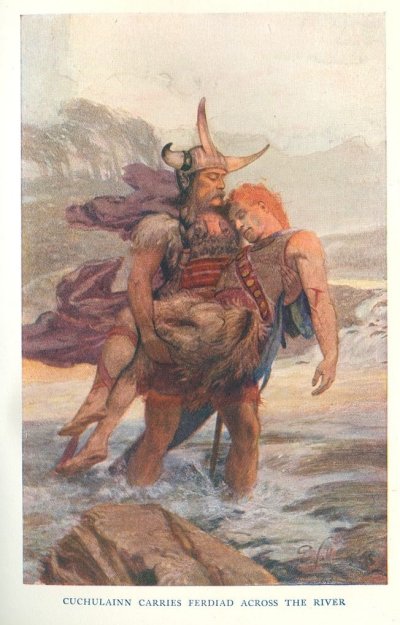
Sétanta dragged himself over to a standing stone, a relic of a forgotten time. He stood, even as his entrails fell around his hands and tied the raw pink bands three times around the stone, binding himself upright. His legs buckled and gave way. The war-host advanced towards the stone. The dying champion was muttering something to himself, again and again. Then he threw his head back and drew a rush of air into his lungs. The younger lads got the worst of it. The older and more experienced warriors had just enough time to clap their hands over their ears.
Sétanta screamed.
The closest man to the stone keeled over instantly, unconscious, black blood spurting from his ears. Those that were lucky would feel a sick, throbbing in their heads for almost a month. Sétanta’s chin drooped, finally touching his chest. A sigh whispered from his mouth. and his eyelids closed. As his head lolled to the side, the war-host stood paralyzed. Surely, at any moment, those sleeping eyes of many-coloured fire would snap open and they would be torn from limb to limb.
The eyes did not open. A look, oddly like that of a sleeping child untroubled by the future, was frozen on the warrior’s face.
A while later, Lugaid and his company marched up to the stone, eager to claim a trophy from the demigod’s corpse. When he reached out to take the ivory-hilted sword still clutched in Sétanta’s fingers it slipped, taking Lugaid’s arm off at the wrist. The body stood upright against the rock, unarmed.
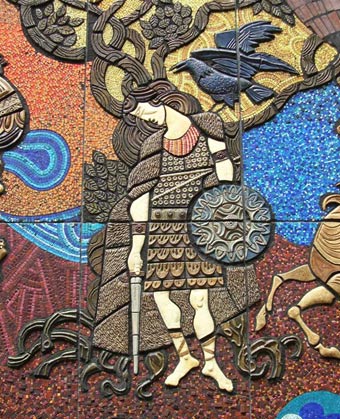
A raven landed on Sétanta’s shoulder and began to nuzzle its beak against his neck.
Strangely, the bird looked like it was greeting an old friend.
 Pablo Lacalle Writing
Leave a comment