The following chronicle was cobbled together from a patchwork of archival documentation, medical records, and letters related to the life of the once-celebrated Commander Jean-Jacques Auguste. I would like to thank Monsieur Auguste’s estate for graciously providing access to the late Commander’s private journal.
I will reluctantly admit that I cannot provide any comments as to whether the events recounted here are credible or not. History, mendacity, and superstition shape this epistolary puzzle: I leave it to my trusty readers to be judges, juries, and (dare I say it?) executioners of time’s sordid legacy. But enough from me-—it is time for the living to hold their tongues, and for the dead to speak.
Report drafted by Garrison Commander Jean-Jacques Auguste, Second Franco-Mexican War, 2nd of August 1865.
“Frightful business with a spot of local unrest. Juárez loyalists took up arms to storm the munitions arsenal. Attack was quickly thwarted. Minimal French casualties sustained. Loyalists apprehended.
One civilian death reported, a young native girl. Unable to properly ascertain the culprit. Most likely an accident.
Family has been duly compensated for the cost of the burial. Men are in high spirits after the victory. There seems to be no indication of further violence.
Glory to the Emperor and may God have mercy on our souls.”
Private correspondence of Garrison Commander Jean-Jacques Auguste to Madame Madelaine Auguste, 3rd of August 1865.
“They hanged the brigands today in the courtyard, as the sun was setting. Oh, my dove, what a beastly hour to take the life of a man! A condemned man should be permitted to leave this earth beneath a clear sky. Instead, they shuffled onto the gallows, stained blood-red by the dying light of the evening. They cast great shadows for men so small.
I hope these words I write are not too displeasing. I appreciate your desire to be informed of my doings overseas, but I can make no promises as to the content of these letters. The work of a soldier is grim business, and our duties here in Mexico are a far cry from the parades in honour of the emperor back home. I still remember the blush on your cheeks as I strutted in that silly dress uniform. Good heavens, I looked like a wedding cake! I would rather you hold onto on to that image of this proud fool who loves you too much for his own good, than that of the battered, tired man who writes this now.
The crowd did not cheer when the brigands swung. I am not sure if it would have been better if they did.
I simply wish for this confounded war to end. One can only hope that braggart Juárez sees sense and forfeits the debt these Mexicans refuse to pay to the Crown! My palate is more refined for our evening treats at the Boulangerie Viennoise than these base offerings of blood from a gaggle of Cains.
Oh darling, that I could once more see fields of dew-slick grass, feel the grey mist of an evening rain! I struggle to put it into words, but this country’s soil does not agree with me.”
Excerpt from the personal journal of Garrison Commander Jean-Jacques Auguste, 3rd of August 1865.
“I watched as they buried the young girl, though I knew I was not welcome. Nevertheless, I felt compelled to see it with my own eyes, as they lowered the coffin into the red clay. I think I buried the family dog in a similar fashion, stuffed inside a crate once used for storing milk.
I could not tell Madelaine. I fear I have already upset her with my grisly talk of executions. Besides, women take the sufferance of children quite poorly. I cannot help but wonder whether they are more sensible for this. It is difficult not to ponder how I would have felt, had it been a daughter of my own sepulchered beneath the dirt. Try as I might, I could not coax out any tears.
The natives said nothing of our presence there, but I feel that for the first time since our arrival we are seen. Before they simply stared, but did not look, those vacant, simple black eyes flitting over uniforms and flags, like a gentleman sighting a vagrant begging for alms on the side of the road. Acknowledging that he is there (as a stone in your path is) but not recognizing him as a thing that lives. I fear the natives see us clearly now, and anything that lives, one knows, must also bleed.
The searing winds have picked up, and they unearth a putrid smell. My only hope is that any threat of further violence is buried quietly alongside the coffin. It would be a terrible thing indeed for them to lose more daughters, now that they have no fathers left to raise them.
The native girl’s mother did not weep at all throughout the burial. Instead, she simply stared mutely at the earth.
Before I departed, she moved to toss a final clod of parched mud onto the mound, my shadow spreading out to mingle with hers. Native and Frenchman, intertwined by an umbilical stretch of darkness, knotted over the remains of a murdered girl.”
Private correspondence of Garrison Commander Jean-Jacques Auguste to Madame Madelaine Auguste, 9th of August 1865.
“…. a most unusual occurrence was bought to my attention this morning, my darling. It appears that one of the men, Maxime Dupont, refuses to participate in drills as expected of him.
I investigated further myself, as the lad in question has always been a most noble, patriotic, and proud fellow. I am sure that if you think back hard enough, you will remember Monsieur Dupont, darling, for he was present at on our wedding day. A rather tall, brown-haired chap with crooked teeth, very polite. I recall you remarking that his manners quite impressed you, so you will also share my puzzlement.
Upon being questioned as to the nature of this bizarre attitude, Monsieur Dupont refused to explain himself properly. He appeared to be melancholic and convinced that he was under severe risk of being harmed. Monsieur Dupont’s condition was serious enough that he has been temporarily placed under the care of our physician.
Most likely, this is the consequence of too much time spent underneath the sun. That, or there may be some thuggish behaviour carried out underneath my nose by scoundrels harassing Monsieur Dupont. Regretfully, it would not be the first time this has happened within the army, though I pray such shameful deeds are not the cause of his distress.
I do hope you are taking care of yourself, my dove. The French heat is often as merciless as the brands of Mexico. It heartens me that you took my last letter so well, though I feel I must apologize for indulging in gory details. Do try out the new hat I have sent if it has arrived already. I am certain it will be the envy of all your reading society.
I tried to look over the Baudelaire you enclosed for me, but I confess I do not really understand it. It will fall to you to help me through it when we are in each other’s arms once more.
Your love, and faithful servant, Jean-Jacques.”
Report drafted by Garrison Commander Jean-Jacques Auguste, Second Franco-Mexican War, 11th of August 1865.
“……. Dupont’s case continues to worsen. Has been isolated away from the rest of the
men for his own safety, and theirs. Have ordered him to be physically restrained. He insists on incurring grievous wounds upon his own person. Ordered his quarters to be lit constantly.
He is at his most demented in the presence of darkness. No certain diagnosis as of yet. Cause of madness is still unexplained. Private Dupont is physically in perfect health and has yet to see battle.
Have instructed for the old well to be inspected, and a new well to be dug. Contamination in the water may explain Dupont’s behaviour. Have also issued an investigation following frequent reports of whoring and men soliciting the services of native girls. I would not be surprised to discover that the diseased patient is hiding the initial symptoms of syphilis.
This unfortunate circumstance has taken a toll on morale. However, I am confident order will be reinstated soon. Have personally attempted to interview Dupont, but there is nothing of value to report in his testimony.”
Entry from the personal journal of Garrison Commander Jean-Jacques Auguste, 14th of August 1865.
“Monsieur Dupont passed away this evening. The poor man resorted to chewing out his own tongue to end his life. There is little in this world more pitiful than suicide, but even this defies belief. The physician found him drowned in his own blood, the pink stump of flesh a bulging mass inside his throat. It was wedged so firmly in the poor devil’s gullet that they had to slit it open for removal.
This is not the handiwork of a syphilitic lunatic, and I confess, to my great disgrace, I have not been entirely honest in my reports of Dupont’s behaviour. Yet, in my defense, there are certain happenings so outlandish that to relay them to my superiors would, at best, question my authority and, at worst, my own sanity.
The day before he bit out his own tongue, Monsieur Dupont fainted, screaming in fear of a little girl.
A widespread search was conducted as to whether any of the native population had managed to infiltrate the barracks. No foreign presence, never mind a little girl, was located. I would be remiss not to mark the unsettling echoes of the Mexican child buried two weeks ago, but it would be preposterous to fall into the waiting jaws of superstition. It is a ravenous beast that gluts itself on paranoid delusions and self-fulfilling prophecies.
That being said, I find it hard not to attach any importance to Dupont’s words the night before he expired. All the while, he shrieked the same three words repeatedly. Even when fatigue overcame him, he moaned them out in a stupor: Solid. Dark. Shadow. Solid. Dark. Shadow.
The bizarre nature of this…incantation has kept me from further reporting the event. After all, the words make so little sense.”
Emergency message delivered to Garrison Commander Jean-Jacques Auguste by Chasseur Hugo Verne, 17th of August of 1865.
“…whilst on sentry duty this evening, me and Garnier and I spotted movement from up on the garrison. The watchword was asked for. No answer was given. No reply or any more movement was noted.
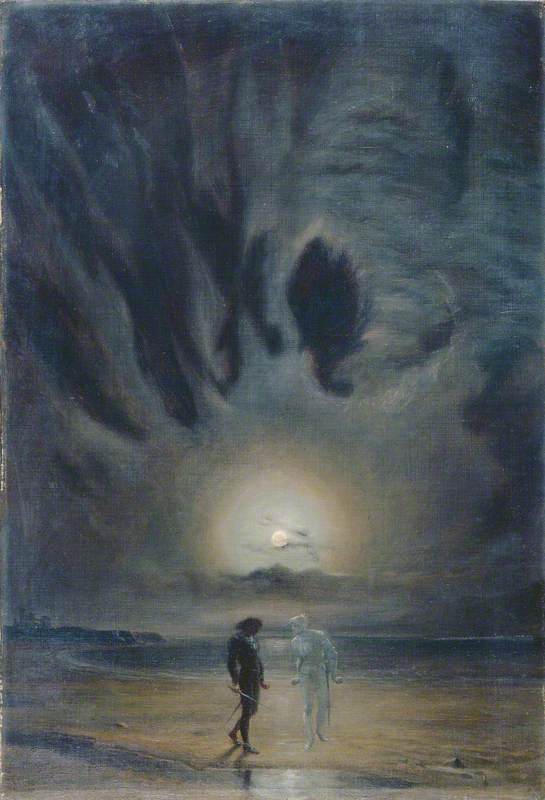
Later, around midnight, movement again. Garnier and I observed a solid, dark shadow on the Eastern wall. I note solid, Commander Auguste, begging your pardon, as this wasn’t a trick, and Garnier can back up my statement.
Lost sight of the intruder before we could get any closer. No evidence of the stranger’s presence could be found, no footprints or anything of the kind.
I believe it is for the best, if you don’t mind my speaking out of turn, Commander Auguste, to consider more security along the walls. The ease with which this intruder fooled both me and Garnier is……. troubling, as on my honour as a Christian, neither of us were neglecting our post or sneaking a drink that night and were both on the highest of alerts.”
From the personal journal of Garrison Commander Jean-Jacques Auguste, 17th of August 1865.
“I do not know what to make of Monsieur Verne’s report. Recent circumstances leave me shaken to my core. I have prayed to God for assistance in this matter and asked Him to dissuade these fancies that threaten to plunge me into the raving world of witches and lunatics. He remains silent as the crowd that saw those brigands hang, a mute disgust watching me with sable eyes. Quietly measuring out a noose to circle my neck.
It was those words again, in Monsieur Verne’s tale. Words said in sequence, that he could not have possibly heard from the departed Monsieur Dupont, who howled them out only to a physician and to me.
Solid. Dark. Shadow. Solid. Dark. Shadow. What on earth does it mean? Is this a code or cipher, a motto whose significance I am simply too slow to understand? Yet there again it appears, creeping through the flow of his speech like mold, slowly spreading from beneath its dank abode, solid, dark shadow, solid, dark, shadow, a redundancy made manifest. Nevertheless, I find myself repeating it as I would my nightly prayers.
How can I not peer into the folds of night and imagine, hidden in them, a shape, biding its time, observing me in silence, waiting for my back to be completely turned to lunge at me in fury?
The longer that I squint into the shadows, the more they seem like slippery coils of matter coalescing and drifting apart-but no, no, they do not yet appear dark, or solid, though shadows they may well be. The candlelight strikes at their questing tendrils and whips them back. What fear is there for a soldier of the Empire that quelled this dry and savage land when faced with goblins, ghouls, and childish inventions?
Ours is an age of reason, and to reason I must pledge myself as servant and crusader.”
Private correspondence of Garrison Commander Jean-Jacques Auguste to Madame Madelaine Auguste, 24th of August 1865.
“Though it pains me to admit it, Madelaine, I exhumed the child’s corpse yesterday, alone, under the cover of darkness. Of late these days, I have been more than a little dishonest both to you and to my superiors. I understand this must confuse you, but all I ask of you is to try and to understand.
It was my bullet that ended the poor thing’s life, a terrible accident. I would never have committed such an atrocity in good conscience-you know how much I love children, oh Madelaine, how can I make you see it? The smoke, the shouts, the haze of gunpowder…. a stray bullet, but nevertheless, one from my own gun. It was dismissed as a tragedy, a slip-up. You are the only soul that knows this, the only soul that I can trust to lead me with your perfumed hand through this field of thorns.
Please, if the holy bonds that join us as man and wife could ever be called upon for a matter such as this, let me call upon them now.
Should I have come clean, admitted the murder to be my fault? Would my superiors have cared? We all knew the bullet that the physician removed from her heart was of French make. Yet no uproar was raised, no guilt doled out-we all witnessed it, but only I saw. Madelaine, my love, the world will never know it was my rifle, the. The world does not want to know, but I will always bear that memory upon my shoulders, splinters, and all.
And now all this talk of specters and shapes and death, it is choking me, Madelaine. Even now I question the decision, but it is for the best neither the Mexicans nor my men know of my momentary lapse of good conscience. I had to know, had to ensure that shame and rumour did not run amok any longer through my garrison. The chaos would be unimaginable. I rest easy with mud beneath my fingertips rather than innocent French blood staining my palms. Some doubts are best put to rest expeditiously and without fanfare.
The fire that burnt what remained of the native girl left nothing solid indeed. Though try as I might, no matter how high I fanned the flames, I could not quite dispel those infernal shadows.”

Report taken from the medical journal of Garrison physician Jean-Baptiste Rochefort, 26th of August 1865.
“Deceased have been identified as Chasseurs Hugo Verne and Charles Garnier. Monsieur Verne’s wounds point to a shattered skull and broken neck. Body was found at the bottom of the stairs leading to the watchtower.
Little blood found on the stairs themselves, indicating Monsieur Verne threw himself, or was thrown, impacting beside the final steps with tremendous force. Vertebrae in the neck completely pulverized. Serious lacerations observed on Verne’s hands, torso, and feet. Bite-marks and scratches from a human hand, some deeper injuries, from a blade of some kind. Unable to accurately identify marks as those of an attacker or self-inflicted.
Monsieur Garnier found impaled through the jaw on the bayonet of his service-issued rifle. Blade lodged firmly in the top of the cranium. Gunpowder burns on Garnier’s hands and face are evidence of an attempt at discharging his weapon. Angle of entry of the blade proves Monsieur Garnier was aided by gravity. Monsieur Garnier’s torso and extremities bear signs of grievous corporal punishment.
Presence of unusual blemishes in the eyes of both deceased. Cloudy bruises on the surface of the pupil are reminiscent of a solid, dark shadow.”
Private correspondence of Garrison Commander Jean-Jacques Auguste to Madame Madelaine Auguste, 5th of September 1865.
“This will be the last letter I send to Paris, my darling, not because my love for you has dimmed in any way, but because I believe it is best you separate yourself from a wretch such as I before it is too late. You may weep when you read these words, you may call me cruel, but it is the necessary cruelty of the monk who shreds his back to ribbons in the pursuit of salvation.
As it is, I have resigned myself to the knowledge that even in death, we will not be reunited. I will still remember you fondly, though my eyes be blinded with hot blood from the boiling lakes of Hell. I sleep next to the fire now, for its blazing light is infinitely preferred to the cold, the teeming, wet womb of shadows that slide themselves over my skin, seeking to pour into my ear, thrice blasted and thrice infected for the purpose of my ruin.
Yet I confess myself a coward, for still I wince and turn away when the edges of the fire’s tongues lick at my cheeks and fingers. If I cannot even stomach these flames, what will I endure in the dungeons of Tartarus?
I did not mean to kill that little girl. It was an accident; I could not have seen her!
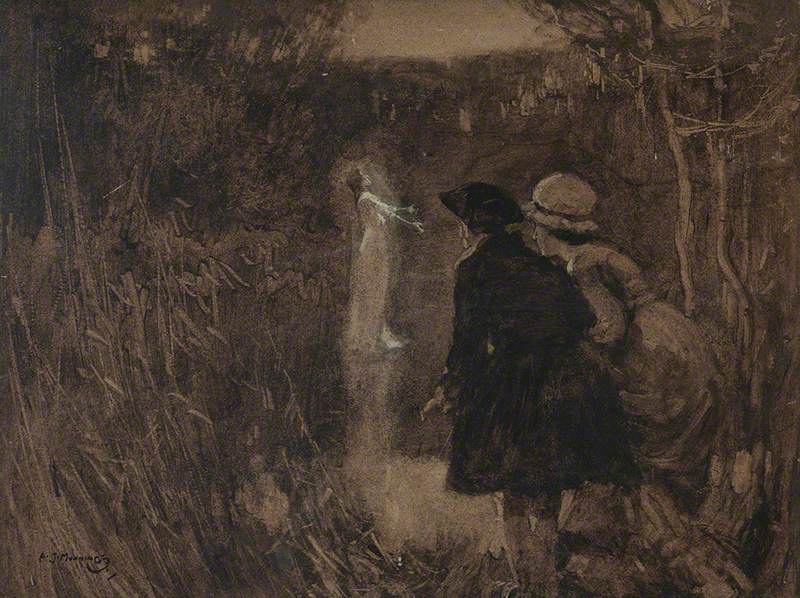
But…I saw her the other night, in the hallway outside my quarters. Scoff at my words, denounce them as the fevered delirium of a madman driven insane by guilt. She-she? No, it was just… standing stood there, the silver mist of moonlight hovering like a miasma behind it.
Before I had dismissed the reports of my men of the “solid, dark shadow” but now I know what they meant. That slight figure did not move, but even surrounded as it was by its brethren, the shadow of the girl hung in space, a rip in the fabric of the world.
Perhaps the worst thing about it was its weight. The thick, heavy feel of its shape that belied it as something tangible, something set in its place and its purpose. Not an airy, specter that could be passed through, but a creature whose hands could touch andg rasp and feel and hurt and choke and scratch………its footsteps leaden thuds advancing onwards at the call of twilight, fingers smudging their blackened grime on doorknobs forced open, sabers shattered, rifles broken.
Even then I understood that though it could be touched, it could not be killed. Any round discharged at that chest would be devoured by the hungering dark. Within the shape of that thing there dwelled the entrails of midnight, a corruption that had leeched its shadows from our hearts and minds and gorged itself, waiting to multiply.
Had it been lying in wait, spreading like gangrenous rot ever since the winds blew that rancid stench from within the murdered girl’s coffin? Or maybe, like a seed, like grain, it was we who had carried it. Packed it in straw, sealed in crates, stuffed tight alongside the cannon, the rifles, the swords, the mortars, the grapeshot, and gunpowder sent over in droves on the emperor’s boats to germinate in this world of unspoken, bloodied truths.
I had stared at similar shadows on the prow of my ship as it crossed the Atlantic, dripping from the folds of the tricolore, I had glimpsed it crawling inside shell-casings and lurking behind my shaving-mirror, wearing my face as a carnival mask. It must have helped me dig up the girl. The task had seemed faster that night, as if some being was scrabbling at the wood of the coffin from below, eager to be free.
I ran. Why bother denying it? I ran, tearing down the corridor, bolting back towards the fire, towards the light that could beat back the shadows. It did me little good. It never will. This terror that stalks us all is not a foe to be vanquished by any means of reason, for we have always been endarkened.
I can feel it within me now, from where it peeled off and slipped into my own shade. The filth is a second skin, sewn onto my back. It hovers over my head, stretching and dancing on the walls as it catches the light, doubling my every move like a mime, an ape with a thousand forms. How could I possibly return to France, nestling this parasite in my bosom, a prodigal son of lies returned to the place of its birth? It would flit from host to host, trailing the blossoms of its tarnish in its wake, curdling the souls that already hide the kernels of that self-same seed.
I will not be the father to a legacy of shadows.
I love you Madelaine, though you wish I never had. Remember the gilded uniform, remember the walks by the Seine, the pastries shared by lamp light. Please remember my face, one last time, before its features run melt into a pall.”
Excerpt from medical records obtained from Charenton Asylum, Charenton-Saint-Maurice, 28th of October 1865.
“Monsieur Auguste’s mental state has not shown any significant indications of improvement. Almost a month has passed since his internment and transportation from Mexico, and he continues to be stricken with active and severe attacks of melancholia.
Recently discharged from the infirmary after a case of self-mutilation, Monsieur Auguste flayed chunks of his own feet with a stolen kitchen knife. Claims it was to cut away his shadow.
Fear of the night has repeatedly been observed being his most obvious and frantic concern. Monsieur Auguste has been moved into solitary quarters for his own safety.
Admittance today of a new lunatic. Assaulted several prostitutes due to bouts of psychosis likely triggered by a prolonged abuse of absinthe. Request for further medical examinations for possible venereal diseases carried by the patient: his body is covered in unusual blemishes, like solid, dark shadows.”






 Pablo Lacalle Writing